Take a beat
When it's time to slow down, take a breath, and maybe even briefly disappear amid an experience of overwhelm

I’m writing this on the morning after a day when temperatures reached forty-three degrees in the city and higher further north in my state. Massive swathes of the state are on fire and many of my family members and friends have evacuated from their homes. Dozens of people have lost homes, pets, and precious belongings, including family of people close to me. The fires are still burning out of control. Also, I am active in keeping track of analyses of world politics, and obviously the past week and the weeks preceding have been intense in many parts of the world, including in my own country. Today, the smell of smoke is heavy in the air. I’m worried about the fires that are still burning and threatening homes and communities. Looking further afield, I’m constantly concerned about what is happening both within and outside my country, politically and socially. Like countless others, I’m running low, energy-wise, and I need to replenish myself because there’s plenty of work to be done yet and I want to be strong for it. I know I’m very privileged in having the capacity to do so, as unlike many others, I’m not in imminent danger as I sit down and write today.
Not long ago, I watched a TV show set in Belfast and kept noticing an expression used by the characters.
Take a beat.
The Northern Irish saying means something like just wait a moment, take some space, breathe, maybe calm down, take your time before you say or do the next thing. I’m not always good at doing any of those things.
I’m writing a book that is essentially about the deep and complex grief I feel in relation to my mother. Maybe it’s the hardest writing I’ll ever do. It’s not flowing smoothly, and there’s a good chance it never will. If I think of our relationship as a body of water, then it was without a doubt not one with a tranquil surface or calm depths.
I don’t think this is a book that will allow me to write it as though rowing a boat on a pleasingly flowing stream. That’s OK. None of my writing emerges like that. Yet not being immersed in a smooth flow of writing is causing me considerable anxiety.
Writing is how I make sense of everything, especially that which has little sense to it. There is great power in being able to lay out the mess of everything, in writing, and see it for exactly itself, the mess, the textures and shapes, the holes, rips and gashes, the absences, the noise and silence. Before it’s written, for me, the mess is simply too hard to make out when I look its way, and that is overwhelming and sometimes stultifying.
For now, this particular mess is remaining hard for me to make out. I think it won’t quite allow itself to be looked at yet. It’s stubborn, and that’s hardly surprising. My mother was stubborn, and I’m one hundred percent sure she thought of me as stubborn.
Most of the time, my daily rhythms and routines work for me. Keeping to them is what allows me to start and finish my writing projects. But this book is turning out to constitute exceptionally hard work and I’m writing it within a context of alarmingly hard times in the world.
I’ve been simply taking out my journal and catching up with myself, rather than focusing on drafts and notes for more formal writing. I trust the rhythms and routines, but I need to take a beat.
(Thanks to that TV show, I can’t help but say the words in a Belfast accent, or what I think one sounds like.)
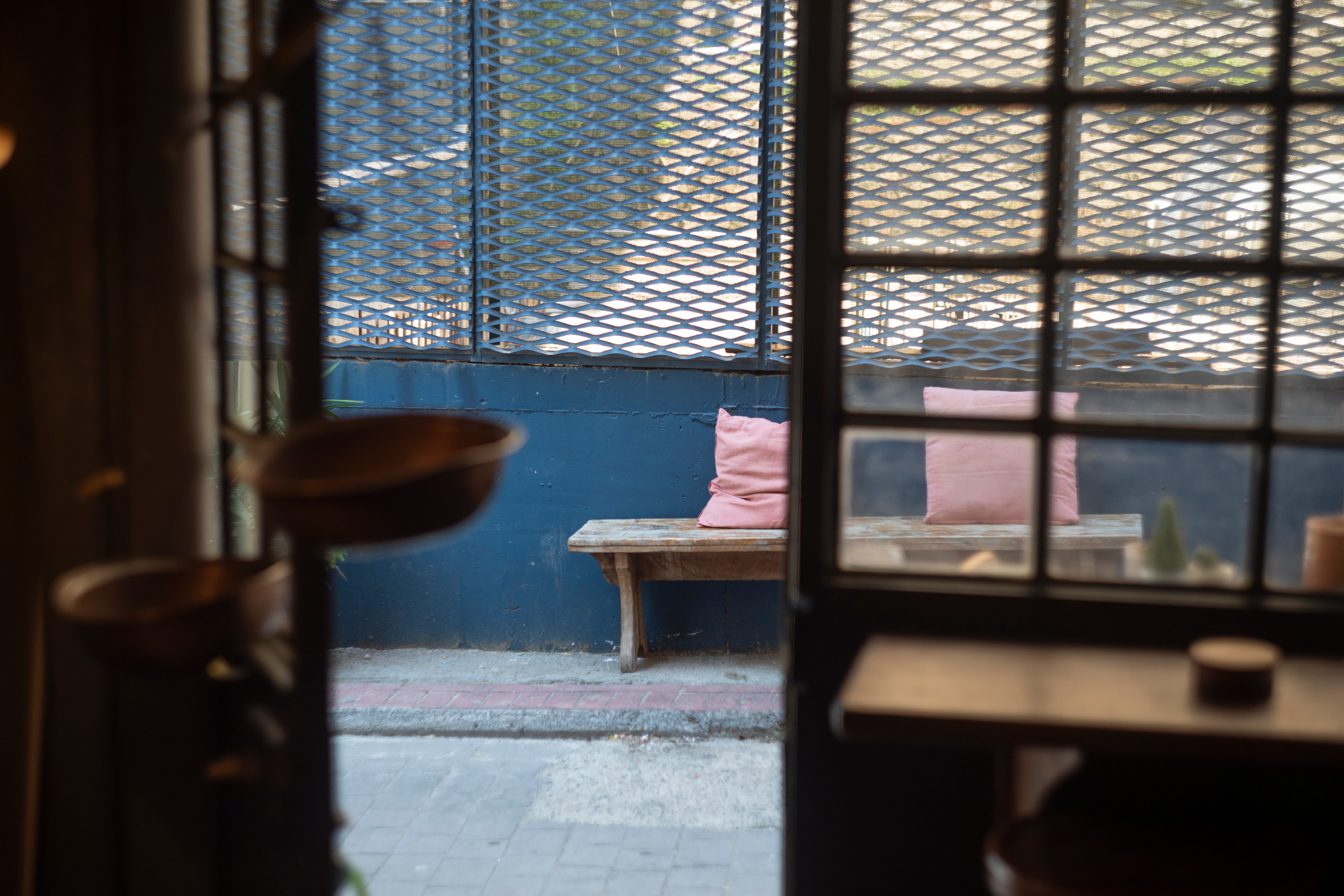
The photograph I’m using here was taken by Alp Eren while I was on a long-durational performance art residency at the wonderful Performistanbul, earlier this year, returning a few weeks before Mum died. Alp tailed me around the streets of Istanbul, subtly tracing my steps and documenting my work as I carried out my daily rituals of writing in public spaces. In some of the documentation, he’d photograph me working in a particular place and then after I was gone, he’d linger and photograph the remains of where I’d been, capturing first my presence and then my absence. Moments before this picture was taken, I was sitting on the bench with the pink cushions, looking into the cafe where I had just been writing. Then I stood up and walked away, and Alp stayed to capture the absence following the presence.
For now, I’m allowing myself to be just a little absent for a time, absent from my own book, absent from too much news and political analysis, if need be.
Books
Over months, I slowly worked my way through the blue notebook of Helen Garner’s diary volumes, How To End A Story. This was recently interspersed with my reading of The Mobius Book, by Catherine Lacey. One cover of the book is a deep fuchsia pink, the other is turquoise. One text begins at the pink cover, the other at the blue, and they meet in the middle, though one will be upside down until you turn the book around. I decided to start with the blue, simply because I had a migraine aura on the day I began reading, and the turquoise tone was gentler on my sensitive eyes. In the first few pages, I came across references to Marina Abramovic and Sarah Manguso, two creative women who I consider inspirational. Since I’ve finished those books, I’ve read The Calculation of Volume (Book 1), by Solvej Balle. It ended on a cliffhanger. Now, I must read all the books. The last two aren’t written yet, and I’m enjoying the thought of the writer still being on her journey with the story while I’m following behind and reading what she has done so far. I’ll have to write more about this book another time. It deserves its own singular post. Now, I’ve started Ben Shattuck’s The History of Sound. I’m enjoying its gentleness.