Winging it on a storm
On writing fragments amid fragmentation

As I approached the final pages of Ghost Stories, feeling the weight of Siri Hustvedt’s stunning memoir about the loss of her husband, Paul Auster shifting in my hands, I deliberately slowed down my reading. I liked the book’s company and didn’t want it to end, as often happens to me when the book is as good as this one. Eventually, when it did end, I still wanted more.
I looked up 'The Mechanics of Reality', a Lit Hub essay of Hustvedt’s that she mentions in the memoir. Her essay was published as part of a series of tributes to Auster following his death. The term making up the title of Hustvedt’s essay was a phrase used by Auster. Hustvedt includes a lucid explanation of what Auster meant by the term, including:
‘Human lives do not conform to the dull dictates of cultural conventions that pinch perception, distort the world, and claim to represent the real. The mechanics of reality include wild coincidence, astounding fact, and bizarre discovery, or so it seems to us. All such events appear through the filter of human consciousness. We select bits of pieces of experience, turn them into narratives, and make meaning from them.’
This speaks to me as I press on with my current autofiction book project. The book started out as an exploration of the long durational work of mourning over lifetimes. It’s still that, I think. But last year, beginning while I was working on the manuscript in Istanbul and taking part in a long-durational performance art residency with the wonderful organisation that is Performistanbul, I experienced three profound losses in a row. Within just over six weeks, my partner’s mother, my beloved aunt, and my mother died. After that, I was no longer solely contemplating loss and mourning precipitated long ago, as I plunged into the immediacy of loss happening around me. I was too shocked to grieve yet. The book I’d begun absolutely could not remain as the same entity.
But then, it never is the same.
As soon as the notebook or computer is opened and the work begins, a book becomes something other than the one the writer has in mind. This is a good thing. We’d all be bored and boring if we actually knew what we were doing and what the book would be by the time it was finished.
While I was in Istanbul, I was often struck by the fragmentary quality of the city. It’s in a constant state of oldness layered up with newness. The earthquakes that more or less level the city roughly every couple of hundred years ensure a state of perpetual fragmentation. And then there’s the new-on-top-of-old political instability and how it too makes this ancient place feel somehow temporary and fragile at all times.
This book I’m writing is fragmentary in form. I’m aware that sometimes I walk on fragile ground, entering deceptively temporary spaces as I work.
I’ve started to enjoy the process, after a long period of stuckness. This book is not like my other ones, not for me, not in how I’m writing it. At first, I was uneasy. I felt that the book was dragging me in all sorts of contrary directions in a bits-and-pieces way. The whole thing threatened to fall apart at any moment.
In the past week alone, I’ve read and written about moorhens and grey herons, southerly wind systems, St Josephs Foundling Home in Melbourne, the autoimmune disease that is alarmingly subsuming intimate parts of me, the Tuam mothers and babies of Ireland, the Saturday Mothers weekly protest in Istanbul for disappeared people, Ottoman-era clocks and timekeeping, subjective cognitive decline, whirling dervishes, present-day Turkish politics, cemeteries for the nameless, and First Nations truth-telling initiatives in Australia. I’ve also written small fragments about my parents’ early courtship and marriage, and the intricacies of their smoking habits when I was a child. And I’ve tried and failed, again, to write about the last night and morning of my mother’s life and my witnessing of her death.
I’m panicking less all the time, even while the process can feel to me like I’m being blown all over the place like a grey heron on a high wind in a storm (and that would be a totally out-of-place northern Icelandic heron and storm, by the way).
The whole mess is making sense to me, in a no-sense-to-be-had way.
‘The mechanics of reality include wild coincidence, astounding fact, and bizarre discovery, or so it seems to us. All such events appear through the filter of human consciousness. We select bits of pieces of experience, turn them into narratives, and make meaning from them.’
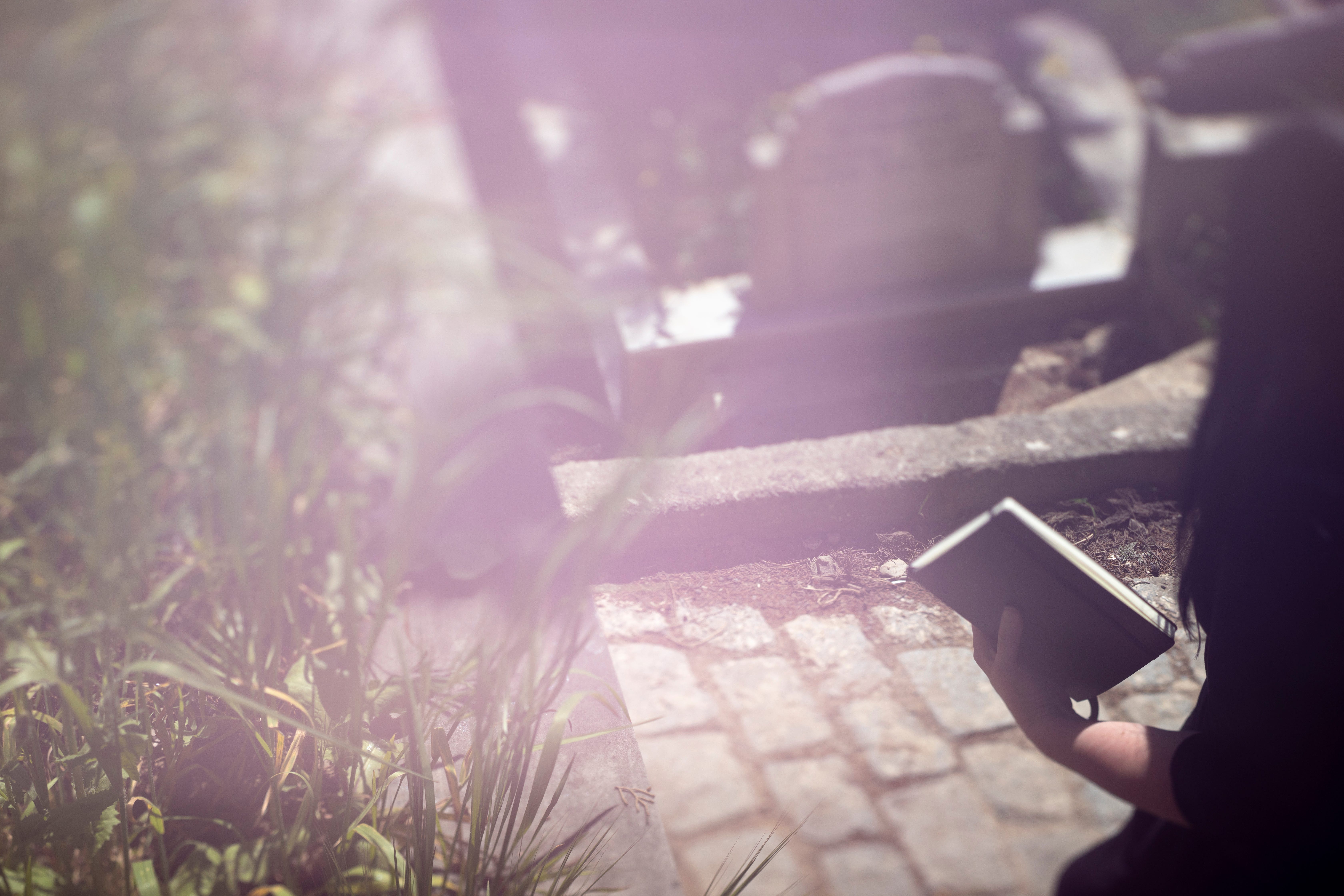
Photograph of me at Pierre Loti Cemetery, Istanbul, Alp Eren, as part of a long-durational performance art residency program at Performistanbul.
‘We select bits of pieces of experience, turn them into narratives, and make meaning from them.’ This quote says it all really, doesn’t it? We could all sit down to write about the same thing and the stories we tell would be as different as our days. I will get to this book! I am struggling with reading though sickness and tiredness, even though reading is almost always the answer and the cure to malaise x